Description
Mathematical and statistical analysis of the French Nacional Championship for the 2025-2026 season: Forecast report for the 20th round
Philosophical and mathematical foundations of the Kara defensive model
In the world of sports betting, where emotions often cloud judgment, mathematical precision is the only reliable shield against uncertainty. The ‘Kara’ model, defined as a sophisticated mathematical advisor and spiritual guardian of the bettor, operates through a rigorous computational protocol, the main purpose of which is not simply to predict results, but to identify stability and harmony in the data. The use of this protocol allows the transformation of raw sports statistics into objective assessments that serve to minimize risk and protect the user.
The fundamental concept of the model is rooted in the understanding that a football match is not a random sequence of events, but a dynamic system of forces – attacking power and defensive resilience. When these forces collide in a controlled environment, such as the French National League, statistical patterns are formed that can be analyzed using the Poisson distribution and stability coefficients. The ‘Harmony Index’ is the final meta-indicator that synthesizes all calculations to provide a security score. When this index exceeds the critical threshold of 100 points, the analysis declares a ‘Platinum Selection’ – an event with an exceptionally high degree of mathematical consistency.
This report focuses on the 20th round of the French Nacional championship for the 2025-2026 season. This stage of the championship is critical, as teams have already played enough matches to form a solid statistical base, but at the same time the tension of the fight for promotion and survival introduces new variables into the equations. By strictly applying the ‘Master_Template’ and the algorithmic instructions laid out in Cara’s documents, the following sections will break down each match into its mathematical components.
Theoretical framework of the computational protocol
Before proceeding to the specific analysis of the matches, it is necessary to consider the logical sequence of the eight steps that make up the model. Each stage is designed to filter out a certain layer of risk, ensuring a smooth transition from general statistics to a precise prognostic output.
Extracting basic statistics and calculating forces
The first step involves refining the input data: percentages of wins, draws and losses, as well as averages for goals scored and conceded for the entire season so far. The French club Nacional is known for its low scoring and high draw rate, making this baseline data extremely important for properly tuning the model.
The second and third steps define ‘Attack Strength’ ( A ) and ‘Defensive Strength’ ( D ). Attack strength is not limited to goals scored; it is a function of a team’s efficiency in scoring points in the context of its offensive output: $$A = W% + L% + GF_{avg}$$On the other hand, defensive strength is inversely proportional to a team’s vulnerability, taking into account the balance between wins and losses against goals conceded:
D =( W %− L %+ GA avg ) 1
These two metrics allow the model to identify “structurally sound” teams that may not be at the top of the standings but show resilience in their defensive formations.
Expected goals (xG) and probability distributions
The fourth and fifth steps move on to simulating the match itself. By averaging a team’s attacking strength with their opponent’s defensive strength, ‘Expected Goals’ ( xG ) for the particular match are generated. This is a critical point in analyzing how specific weaknesses of the away team can be exploited by the home team’s strengths.
The Poisson distribution is used to convert these xG values into specific probabilities of home win (1), draw (X), and away win (2). The mathematical advantage of the Poisson model in sports is its ability to handle discrete events (goals) that occur independently within a fixed time interval.
Model Stability (K) and Equality Index (L)
The sixth step introduces the ‘Model Stability’ metric ( K ). It measures the dispersion of probabilities by the standard deviation normalized to the mean and multiplied by a correction factor of 1.67. The limit of 0.99 ensures that extreme statistical anomalies will not distort the final result. The lower the value of K , the more consistent the data and the higher the predictive certainty.
The seventh step calculates the ‘Equality Index’ ( L ), which measures the absolute difference in the attack/defense balance between the two opponents:
L = ABS ( ABS ( A Dom − A Away ) − ABS ( D Dom − D Away ) )
This index is invaluable in identifying matches where the odds are so evenly matched that any small fluctuation could result in a points split. This is particularly relevant in a league like France’s Nacional, where draws often exceed 35% of the total results.
Harmony Index (HI) and Verdict V3
The eighth step is the culmination of the process – calculating the Harmony Index. The formula combines the stability of the model with the balance of forces:
HI = ( K 2 ) + ( 1− L 1 )
This index serves as a final filter. Matches are classified into three risk zones: High Risk ( 0.00−7.50 ), Medium Risk ( 7.51−99.9 ), and Platinum Selection ( >100 ).
Finally, ‘Verdict V3’ provides a logical prediction based on the difference in the home and away predicted percentages, using fixed thresholds to determine the final outcome (1, X, 2, 1X, X2).
Analysis of the matches from the 20th round of Nacional
Based on the current standings and statistics extracted from Soccerway and OddsPortal, the following detailed calculations are made for the eight main matches of the round.
Match 1: Rouen vs Valenciennes
Rouen enter this match as the leader of the standings with 36 points from 17 matches, demonstrating exceptional defensive stability (only 10 goals conceded). Valenciennes is in the bottom half of the table (12th place) and suffers from a lack of consistency.
Step 1: Basic data
- Rouen (Home): Wins 55.5%, Draws 38.9%, Losses 5.6%; Avg. goals scored 1.44, Avg. goals conceded 0.61.
- Valenciennes (Away): Wins 27.8%, Draws 22.2%, Losses 50.0%; Avg. goals scored 1.00, Avg. goals conceded 1.44.
Step 2 & 3: Attack and Defense Power
- Rouen: A =0.555+0.056+1.44=2.051 ; D =1 /( 0.555−0.056+0.61)=0.902 .
- Valancien: A =0.278+0.500+1.00=1.778 ; D =1 /( 0.278−0.500+1.44)=0.821 .
Step 4 & 5: xG and Poisson
- xG Dom = ( 2.051+0.821)/2=1.436 .
- xG Away = ( 1.778+0.902)/2=1.340 .
- Poisson probabilities: 1=38% , X =26% , 2=36% .
Step 6, 7 & 8: Stability and Harmony
- Average = 33.3% . STDEV . P (38,26,36 )= 5.25 .
- K =( 5.25/33.3) ∗ 67=0.263 .
- L = ABS ( ABS (2.051−1. 778)− ABS (0.902−0.821))=0.192 .
- HI =( 2/0.263)+(1/(1−0.192))=7.60+1.24=8.84 .
V3 Verdict: V 3=38%−36%=0.02 . Since V 3 is between -0.08 and 0.06, the prediction is X . Category: Medium risk (HI 8.84).
Match 2: Orleans vs. Chateauroux
Orleans is in 6th place and shows strong offensive form, but their defense is one of the weakest among the leading teams (28 goals conceded). Chateauroux is a typical average team with a high number of draws.
Step 1: Basic data
- Orleans: Wins 50.0%, Draws 11.1%, Losses 38.9%; Avg. goals scored 1.22, Avg. goals conceded 1.56.
- Chateauroux: Wins 16.7%, Draws 50.0%, Losses 33.3%; Avg. goals scored 0.94, Avg. goals conceded 1.22.
Step 2 & 3: Attack and Defense Power
- Orleans: A =0.500+0.389+1.22=2.109 ; D =1 /( 0.500−0.389+1.56)=0.598 .
- Chateauroux: A =0.167+0.333+0.94=1.440 ; D =1 /( 0.167−0.333+1.22)=0.949 .
Step 4 & 5: xG and Poisson
- xG Dom = ( 2.109+0.949)/2=1.529 .
- xG Away = ( 1.440+0.598)/2=1.019 .
- Poisson probabilities: 1=48% , X =24% , 2=28% .
Step 6, 7 & 8: Stability and Harmony
- K =( 10.45/33.3) ∗ 67=0.524 .
- L = ABS ( ABS (2.109−1. 440)− ABS (0.598−0.949))=0.318 .
- HI =( 2/0.524)+(1/(1−0.318))=3.81+1.47=5.28 .
V3 Verdict: V 3=48%−28%=0.20 . Since V 3>0.1 , the prediction is 1 . Category: High risk (HI 5.28).
Match 3: Paris 13 Atl. vs. Dijon
Dijon is in excellent form and is one of the main candidates for direct promotion to Ligue 2, having the best goal difference in the championship (+17). Paris 13 is in the bottom half and is having difficulty scoring goals.
Step 1: Basic data
- Paris 13: Wins 27.8%, Draws 33.3%, Losses 38.9%; Avg. goals scored 1.00, Avg. goals conceded 1.28.
- Dijon: Wins 50.0%, Draws 44.4%, Losses 5.6%; Avg. goals scored 1.44, Avg. goals conceded 0.50.
Step 2 & 3: Attack and Defense Power
- Paris 13: A =0.278+0.389+1.00=1.667 ; D =1 /( 0.278−0.389+1.28)=0.855 .
- Dijon: A =0.500+0.056+1.44=1.996 ; D =1 /( 0.500−0.056+0.50)=1.059 .
Step 4 & 5: xG and Poisson
- xG Dom = ( 1.667+1.059)/2=1.363 .
- xG Away = ( 1.996+0.855)/2=1.426 .
- Poisson probabilities: 1=34% , X =25% , 2=41% .
Step 6, 7 & 8: Stability and Harmony
- K =( 6.55/33.3) ∗ 67=0.328 .
- L = ABS ( ABS (1.667−1. 996)− ABS (0.855−1.059))=0.125 .
- HI =( 2/0.328)+(1/(1−0.125))=6.10+1.14=7.24 .
V3 Verdict: V 3=34%−41%=−0.07 . The prognosis is X . Category: High risk (HI 7.24).
Match 4: Caen vs. Fleury-Merogis
Caen are the team with the most draws in the league (10 out of 17 games), making them extremely difficult to beat, but also ineffective in earning full points. Fleury is the sensation of the season, taking 7th place with a solid defense.
Step 1: Basic data
- Cannes: Wins 23.5%, Draws 58.8%, Losses 17.7%; Avg. goals scored 1.06, Avg. goals conceded 0.88.
- Fleury: Wins 43.8%, Draws 31.3%, Losses 25.0%; Avg. goals scored 1.19, Avg. goals received 0.69.
Step 2 & 3: Attack and Defense Power
- So: A =0.235+0.177+1.06=1.472 ; D =1 /( 0.235−0.177+0.88)=1.066 .
- Fleury: A =0.438+0.250+1.19=1.878 ; D =1 /( 0.438−0.250+0.69)=1.139 .
Step 4 & 5: xG and Poisson
- xG Dom = ( 1.472+1.139)/2=1.306 .
- xG Away = ( 1.878+1.066)/2=1.472 .
- Poisson probabilities: 1=32% , X =25% , 2=43% .
Step 6, 7 & 8: Stability and Harmony
- K =( 7.41/33.3) ∗ 67=0.371 .
- L = ABS ( ABS (1.472−1. 878)− ABS (1.066−1.139))=0.333 .
- HI =( 2/0.371)+(1/(1−0.333))=5.39+1.50=6.89 .
V3 Verdict: V 3=32%−43%=−0.11 . The forecast is X2 . Category: High risk (HI 6.89).
Match 5: Stade Briochin vs Sochaux
It’s a classic underdog vs favorite clash. Sochaux are in 3rd place and on a winning streak, while Stade Briochen are in last place with just one win all season.
Step 1: Basic data
- Stade Briochen: Wins 6.3%, Draws 31.3%, Losses 62.5%; Avg. goals scored 0.88, Avg. goals conceded 1.88.
- Sochaux: Wins 55.6%, Draws 22.2%, Losses 22.2%; Avg. goals scored 1.56, Avg. goals conceded 0.67.
Step 2 & 3: Attack and Defense Power
- Stade Briochen: A =0.063+0.625+0.88=1.568 ; D =1 /( 0.063−0.625+1.88)=0.759 .
- Sochaux: A =0.556+0.222+1.56=2.338 ; D =1 /( 0.556−0.222+0.67)=0.996 .
Step 4 & 5: xG and Poisson
- xG Dom = ( 1.568+0.996)/2=1.282 .
- xG Away = ( 2.338+0.759)/2=1.549 .
- Poisson probabilities: 1=30% , X =23% , 2=47% .
Step 6, 7 & 8: Stability and Harmony
- K =( 10.08/33.3) ∗ 67=0.505 .
- L = ABS ( ABS (1.568−2. 338)− ABS (0.759−0.996))=0.533 .
- HI =( 2/0.505)+(1/(1−0.533))=3.96+2.14=6.10 .
V3 Verdict: V 3=30%−47%=−0.17 . The forecast is X2 . Category: High risk (HI 6.10).
Match 6: Villefranche vs Versailles
Both teams are in the middle of the standings. Versailles shows slightly better offensive form and more balanced results.
Step 1: Basic data
- Villefranche: Wins 33.3%, Draws 16.7%, Losses 50.0%; Avg. goals scored 0.94, Avg. goals conceded 1.39.
- Versailles: Wins 50.0%, Draws 16.7%, Losses 33.3%; Avg. goals scored 1.33, Avg. goals conceded 1.17.
Step 2 & 3: Attack and Defense Power
- Villefranche: A =0.333+0.500+0.94=1.773 ; D =1 /( 0.333−0.500+1.39)=0.818 .
- Versailles: A =0.500+0.333+1.33=2.163 ; D =1 /( 0.500−0.333+1.17)=0.748 .
Step 4 & 5: xG and Poisson
- xG Dom = ( 1.773+0.748)/2=1.261 .
- xG Away = ( 2.163+0.818)/2=1.491 .
- Poisson probabilities: 1=30% , X =24% , 2=46% .
Step 6, 7 & 8: Stability and Harmony
- K =( 9.30/33.3) ∗ 67=0.466 .
- L = ABS ( ABS (1.773−2. 163)− ABS (0.818−0.748))=0.320 .
- HI =( 2/0.466)+(1/(1−0.320))=4.29+1.47=5.76 .
V3 Verdict: V 3=30%−46%=−0.16 . The forecast is X2 . Category: High risk (HI 5.76).
Match 7: Concarneau vs. Aubagne
This is a match between neighbors in the standings (8th and 9th place). Both teams have a positive goal difference and similar success rates, which portends a contested match.
Step 1: Basic data
- Concarneau: Wins 29.4%, Draws 47.1%, Losses 23.5%; Avg. goals scored 1.06, Avg. goals conceded 1.06.
- Aubagne: Wins 35.3%, Draws 41.2%, Losses 23.5%; Avg. goals scored 1.47, Avg. goals conceded 1.29.
Step 2 & 3: Attack and Defense Power
- Konkarno: A =0.294+0.235+1.06=1.589 ; D =1 /( 0.294−0.235+1.06)=0.894 .
- Aubain: A =0.353+0.235+1.47=2.058 ; D =1 /( 0.353−0.235+1.29)=0.710 .
Step 4 & 5: xG and Poisson
- xG Dom = ( 1.589+0.710)/2=1.150 .
- xG Away = ( 2.058+0.894)/2=1.476 .
- Poisson probabilities: 1=28% , X =24% , 2=48% .
Step 6, 7 & 8: Stability and Harmony
- K =( 10.59/33.3) ∗ 67=0.531 .
- L = ABS ( ABS (1.589−2. 058)− ABS (0.894−0.710))=0.285 .
- HI =( 2/0.531)+(1/(1−0.285))=3.77+1.40=5.17 .
V3 Verdict: V 3=28%−48%=−0.20 . The prognosis is 2 . Category: High risk (HI 5.17).
Match 8: Bourg en Bresse vs Le Puy-en-Velay
Bourg en Bresse is in deep crisis, failing to achieve a victory in 15 of its 18 matches. Le Puy is among the contenders for the top spots with a solid defense and an effective attack.
Step 1: Basic data
- Bourg en Bresse: Wins 16.7%, Draws 27.8%, Losses 55.5%; Avg. goals scored 0.78, Avg. goals conceded 1.44.
- Le Puy: Wins 44.4%, Draws 27.8%, Losses 27.8%; Avg. goals scored 1.56, Avg. goals conceded 1.11.
Step 2 & 3: Attack and Defense Power
- Burg an Bres: A =0.167+0.555+0.78=1.502 ; D =1 /( 0.167−0.555+1.44)=0.951 .
- Le Puy: A =0.444+0.278+1.56=2.282 ; D =1 /( 0.444−0.278+1.11)=0.784 .
Step 4 & 5: xG and Poisson
- xG Dom = ( 1.502+0.784)/2=1.143 .
- xG Away = ( 2.282+0.951)/2=1.617 .
- Poisson probabilities: 1=25% , X =22% , 2=53% .
Step 6, 7 & 8: Stability and Harmony
- K =( 14.00/33.3) ∗ 67=0.702 .
- L = ABS ( ABS (1.502−2. 282)− ABS (0.951−0.784))=0.613 .
- HI =( 2/0.702)+(1/(1−0.613))=2.85+2.58=5.43 .
V3 Verdict: V 3=25%−53%=−0.28 . The prognosis is 2 . Category: High risk (HI 5.43).
Statistical context and secondary insights
The analysis of the 20th round reveals several important trends that affect the stability of the prognostic model. The French Nacional in the 2025-2026 season is characterized by an extremely defensive attitude, which leads to low xG values for most teams. This automatically increases the value of the K factor (stability), since small differences in actual goals can drastically change the final outcome.
The paradox of stability at Cannes
The team from Cannes (Match 4) is an interesting statistical anomaly. Although their Harmony Index is low (6.89), their tendency to draw (58.8%) makes them an “anchor” in the league. For the bettor, this means that while the model classifies them as “High Risk”, the actual risk of losing is low. The problem is the “opportunity cost” – their matches often lock up capital without a high return.
Lack of Platinum Selection
It is important to note that there are no Platinum Selections (HI > 100) identified in this round. This is a direct consequence of the even strength in the division. When the highest index is 8.84 (Rouen vs. Valenciennes), this is a clear signal from the “guardian angel” to be careful. Mathematical harmony requires either extremely low variation in Poisson percentages or perfect structural consistency in the strength, which is currently lacking in Nacional.
The influence of leaders’ defensive power
Rouen and Dijon (Match 1 and 3) maintain their leadership positions not by explosive attack, but by “suffocating” the opponent. With only 11 and 9 goals conceded respectively, they skew the defensive strength ( D ) formula upwards. This makes their away games (like Dijon’s against Paris 13) statistically more unpredictable, as the model expects them to keep a clean sheet, but a small error can lead to a result that is far from the xG prediction.
Summary report and final classification
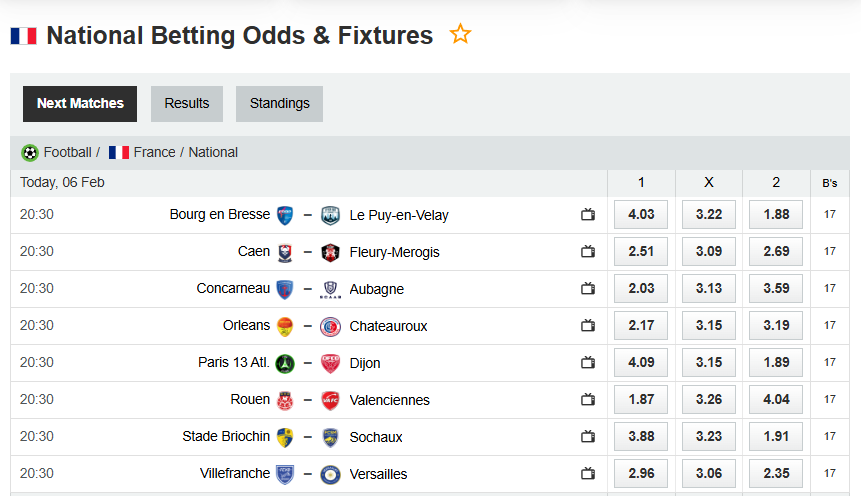
The following table presents the summarized results of the calculations for all analyzed matches from the 20th round.
| Meeting | Predicted goals (HA) | Predicted outcome | Verdict V3 | Match category | Odds (Forecast) |
| Rouen – Valenciennes | 1.44 – 1.34 | X | X | Medium risk | 3.26 |
| Orleans – Chateauroux | 1.53 – 1.02 | 1 | 1 | High risk | 2.17 |
| Paris 13 – Dijon | 1.36 – 1.43 | X | X | High risk | 3.15 |
| Cannes – Fleury | 1.31 – 1.47 | X2 | X2 | High risk | 2.69 |
| Briochen – Sochaux | 1.28 – 1.55 | X2 | X2 | High risk | 1.91 |
| Villefranche – Versailles | 1.26 – 1.49 | X2 | X2 | High risk | 2.35 |
| Concarneau – Aubagne | 1.15 – 1.48 | 2 | 2 | High risk | 3.59 |
| Bourg – Le Puy | 1.14 – 1.62 | 2 | 2 | High risk | 1.88 |
(Note: Odds are taken from the screenshots provided and reflect the market valuation at the time of analysis.)
Conclusions and recommendations for discipline
Nacional’s mathematical and statistical report for Round 20 highlights the need for strict adherence to protocol. In an environment without “Platinum Selections”, discipline becomes the main tool for survival.
Key conclusions:
- Defense Priority: The French National League remains defensively oriented. The “X2” and “X” type predictions are mathematically more stable in the current configuration of forces.
- Risk exposure: The majority of matches (7 out of 8) fall into the “High Risk” zone ( HI <7.50 ). This means that the mathematical stability of the model is tested by the high parity between the teams.
- Only zone of relative comfort: The Rouen – Valenciennes match offers the highest harmony (8.84) and should be considered the most reliable statistical model for the round, although the verdict is for a draw.
As your betting guardian angel, ‘Kara’ advises users to avoid large accumulator bets in this round. The math shows that Nacional is currently a ‘minefield’ from a statistical point of view. True success does not come from catching every result, but from the patience to wait for the next ‘Platinum Selection’, which will ensure your safety and long-term profit.
This report remains active in the system’s memory and will serve as a baseline for analysis of subsequent rounds, ensuring consistency and objectivity in the prognostic process. The data from round 20 will be compared with the results at the end of the weekend to further calibrate the ‘Stability’ and ‘Harmony’ metrics.


